
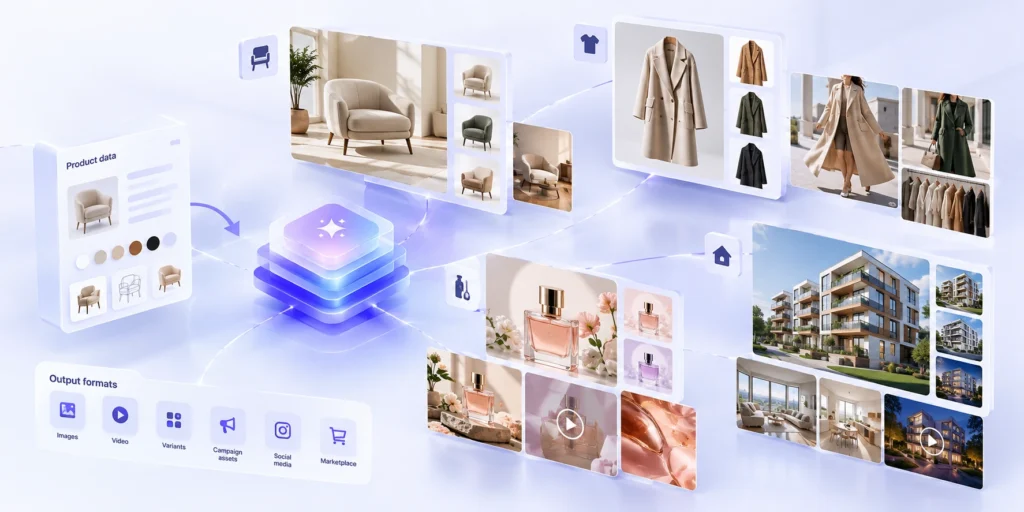
Product Visualization: Imagery, Video and Other Content Generation
E-commerce increasingly depends on visual content. Customers expect to see products clearly, understand their variants and experience them in relevant environments before making a purchase decision. Modern product visualization makes it possible to transform existing product data, reference images and brand guidelines into scalable product imagery, lifestyle scenes, advertising assets and videos.
Need scalable product visuals for your digital project?
Organizations can use AI-assisted visual generation and automation to create market-ready content for online stores, marketplaces, advertising and social media. This changes product content production from a sequence of individual photo shoots into a repeatable digital workflow.
Why Product Imagery Matters in E-commerce
Images, videos and other visual assets become an important part of the purchasing experience. Strong product imagery helps customers understand:
- what the product looks like;
- which colors, finishes and configurations are available;
- how the product can be used;
- how it looks in a realistic environment;
- whether it fits their expectations and preferences.
Traditional ecommerce photography can produce excellent results, but scaling the same production process across hundreds or thousands of SKUs can become expensive and time-consuming. This is where product visualization and AI-assisted content workflows become increasingly useful.
The biggest opportunity appears when visual production becomes connected with the wider e-commerce technology stack. Rather than operating as an isolated creative activity, product visualization can become part of the product lifecycle: Product Data → Visual Generation → Catalogue → Online Store → Marketplace → Advertising → Analytics.
APIs and automation can connect these stages. For example, when a new SKU is introduced into E-commerce Store, its product data and approved reference assets could trigger a workflow that prepares visual variants, sends them for review and distributes approved content to selected channels. This connects product visualization with: API integration, automation, digital marketing, analytics and AI applications. The result is not simply faster image creation. It is a more integrated approach to digital commerce operations.
From Photography to Product Visualization
Traditional e. commerce product photography generally starts with a physical product, photography setup, lighting, environment and post-production. Product visualization introduces another approach. Existing product photos, product data, reference materials and brand guidelines can be used as inputs for generating additional visual assets. A simplified workflow can look like: Product Data → Reference Images → Product Visualization → Validation → E-commerce → Marketing. This does not necessarily replace traditional photography. Instead, it can extend the visual library created from an initial set of reliable product assets.
For example, a company may photograph a core product once and subsequently create additional ecommerce photos for different: environments, seasons, markets, product variants, advertising formats, social media channels. The result is a more scalable approach to product content production.
Launch Product Collections Faster
Traditional visual production often requires coordinating products, studios, photographers, locations, models and post-production. For businesses that frequently introduce new collections, this process can delay product launches. AI-assisted content generation can reduce this dependency by creating additional visual assets from existing product information and imagery. Instead of waiting for a separate production cycle for every campaign, organizations can generate different market-ready visuals for: Product pages → Campaigns → Digital advertising → Social media → Marketplaces. This makes it possible to move from product data to customer-facing content considerably faster.
Showcase More Product Variants
A large catalogue can contain many combinations of colors, sizes, finishes and configurations. Producing traditional photography for every possible combination may not always be practical. Product visualization can help extend coverage across a larger number of SKUs and product options. Instead of showing customers only one representative version, businesses can provide a more complete visual presentation of the catalogue. This is one of the areas where product visualisation becomes particularly useful for organizations with large or frequently changing product ranges.
Standard product photography is often designed to show the product clearly. Lifestyle imagery has a different purpose: it helps customers imagine the product within a particular environment or use case. Through visual generation, the same product can be presented in multiple aspirational settings while maintaining the identity of the underlying product. This makes product imagery useful not only for catalogue presentation but also for storytelling, advertising and brand positioning.
Maintain Brand Consistency
Producing more visuals is very useful when visual identity remains consistent. AI-assisted visual generation therefore needs more than a simple prompt. Effective production workflows can combine: Product Data + Reference Assets + Brand Guidelines + Visual Rules + AI Models. The objective is not merely to generate large volumes of content. It is to create reusable visual production processes that remain aligned with the brand.
The same production approach can support multiple forms of visual content. This is especially valuable because the same product now needs to appear across many channels and formats. A single product may require: Storefront image → Marketplace image → Social ad → Vertical video → Campaign creative. Instead of treating each asset as a separate project, organizations can build a coordinated content generation workflow around the same product information and brand assets.
Product Visualization and Digital Advertising
Digital advertising requires a continuous supply of creative material. A single campaign may need different backgrounds, formats, messages and visual concepts for different audiences. Product visualization can shorten the path between product information and advertising creative. A workflow could look like: Product → Visual Variants → Advertising → Performance Data → New Visual Variants. This makes product content production more iterative. Instead of repeatedly organizing new photo shoots, businesses can create and test additional creative variants while maintaining consistent product presentation. For organizations already investing in ecommerce photography, this approach can significantly extend the value of existing visual assets.
Real Estate Visualization
The same underlying technologies can also be applied for real estate visualization, workflows can be used to present: interiors, exteriors, furniture arrangements, marketing environments. For example, an empty interior can be presented with different furnishing concepts, or a property development can be visualized in multiple styles before final marketing materials are produced.
This illustrates an important distinction: visual generation is the broader technological capability, while product visualization is one specific application of it. In real estate visualization, the subject may be a room, building or development project.
Scalable Product Visual Generation
The most important change is not simply the ability to generate another product image. It is the possibility of turning visual production into a scalable digital capability. Traditional e commerce product photography and ecommerce photography can remain important sources of high-quality reference material. Product visualization can then extend those assets across more products, variants, environments, formats and campaigns. For organizations managing large catalogues or frequent product launches, the workflow can evolve from: Photo Shoot → Editing → Publishing into Product Data → Product Imagery → Visual Generation → Content Generation → Validation → Publishing → Marketing. This allows visual production to become part of the wider e-commerce ecosystem rather than a separate manual activity.
The Future of Product Visualization
As AI-assisted visual technologies develop, the distinction between photography, visualization, video production and digital content creation will continue to narrow. E-commerce organizations will increasingly be able to use the same product information to create a coordinated library of ecommerce photos, lifestyle imagery, advertising creatives and videos for multiple channels. The business value therefore lies not only in producing individual images faster. It lies in creating a reusable product visualization workflow that connects product information, visual content, e-commerce systems and marketing. For organizations that need to present more products, launch collections faster and maintain consistent visual quality across digital channels, product visualization is becoming an increasingly important part of the digital commerce infrastructure.
Bring Product Visualization into Your E. Commerce
Megiti helps organizations integrate product visualization, product imagery and visual generation into wider e-commerce, marketing and automation workflows. This can connect product data, visual content, online stores, marketplaces, digital advertising and other business systems into a more scalable content-production process.
For advanced visual production, Megiti works with a specialized professional visual-production company as a technology partner for Product Visualization services. This allows organizations to transform existing product data and imagery into market-ready product images, lifestyle environments, campaign assets and videos while maintaining brand consistency across digital channels. Whether you need to expand ecommerce photos, automate visual content production, create new product variants or integrate visual workflows with your e-commerce platform, Megiti can help design and implement the required solution.