
Digital Marketing Applying SEO, Ads, GTM, GA4, CMP and CRO
Megiti helps organizations build an integrated digital marketing system that connects organic search, paid advertising, content, analytics, customer data and conversion optimization. The objective is not just to generate traffic, but to attract relevant audiences, and turn that activity into measurable business results.
Our marketing approach combines technology, data and marketing execution into a coordinated marketing strategy that can support customer acquisition, lead generation, e-commerce growth and other digital business objectives.
Integrated Digital Marketing Strategy
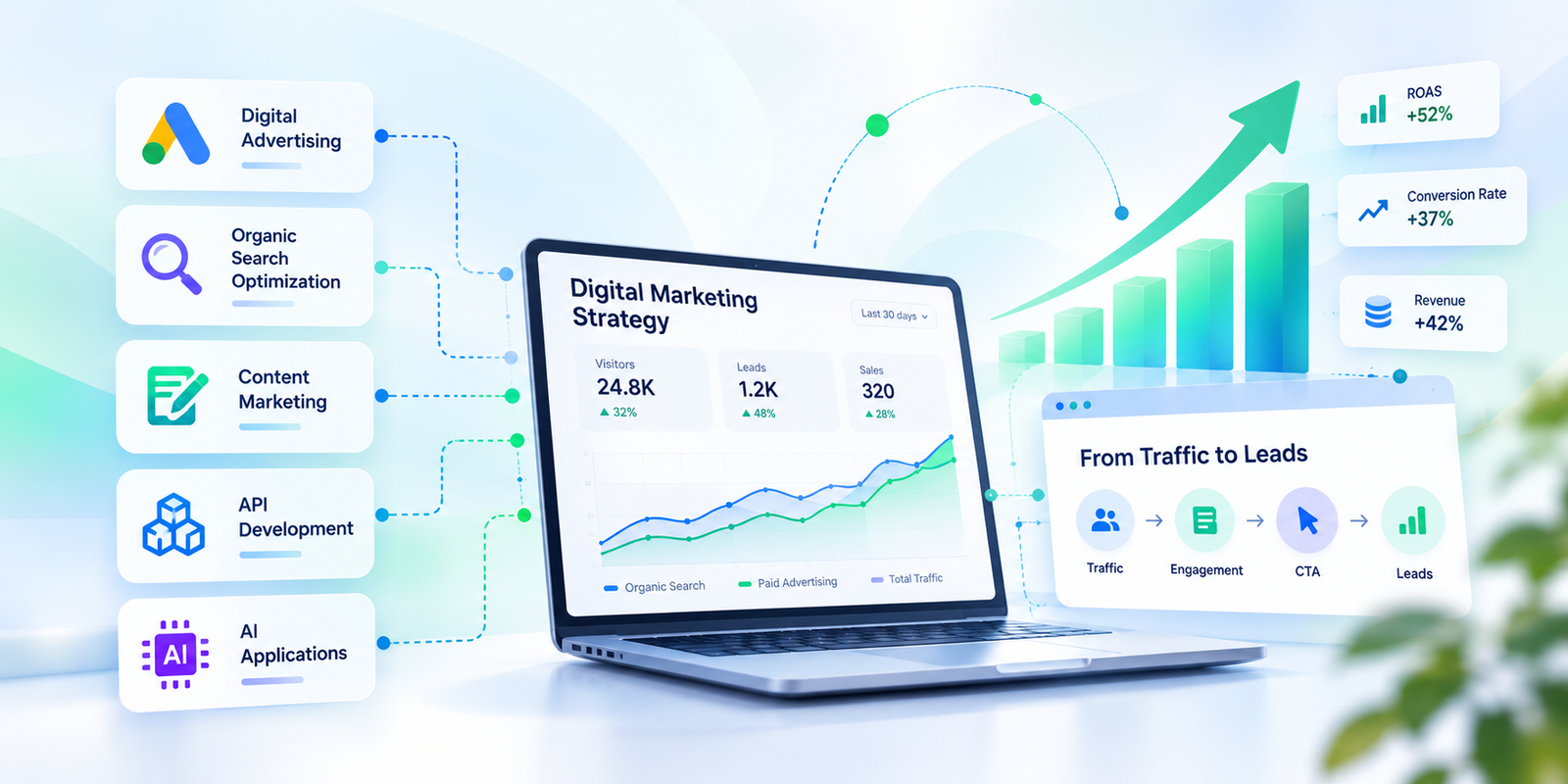
Effective digital marketing requires more than running individual campaigns. Search visibility, advertising, content, analytics and website conversion need to work together. A coordinated marketing strategy can connect: Organic Search → Content → Paid Advertising → Website → Conversion → Customer Data → Analytics → Optimization. This allows organizations to understand how different marketing channels contribute to customer acquisition and where potential customers are lost before conversion. Our approach to marketing and strategies focuses on connecting digital channels with measurable customer actions rather than treating SEO, advertising or content as isolated activities.
Organic Search Optimization creates a long-term foundation for visibility in search engines. Organic search can bring users who are already looking for relevant products, services or information. Within a broader digital marketing strategy, this traffic can then be connected with content, analytics, conversion optimization and other customer acquisition activities.
Digital Advertising supports faster customer acquisition through paid channels such as Google Ads, Meta Ads and other relevant platforms. Paid advertising works best when campaigns are connected with website analytics, CRM data, conversion tracking and the wider marketing strategy. The objective is not simply to buy traffic. It is to understand which campaigns, audiences and messages generate meaningful business outcomes.
Content marketing supports both organic discovery and customer decision-making. Content can support different stages of the customer journey — from initial discovery through evaluation to conversion. Product visualization and content generation can extend this approach with product imagery, video, and advertising assets for digital channels. For organizations operating across multiple digital channels, content generation can also be integrated with AI applications and automation to help create, adapt and distribute content more efficiently.
Remarketing and Conversion Optimization
Remarketing helps re-engage people who have already visited the website, viewed products, started the purchasing process, or completed other important actions but have not yet placed an order or made contact. Remarketing strategies can be segmented based on user behavior — for example, pages visited, products viewed, shopping cart activity, or previous conversions. By combining remarketing with analytics, CRM data, and conversion tracking, organizations can manage audiences more precisely and improve return on advertising investment.
Conversion Optimization is important because traffic alone does not create enough business value. A website needs to guide visitors toward meaningful actions such as requesting a quote, contacting the organization, booking a consultation, submitting a form or completing a purchase. This is where Conversion Rate Optimization (CRO) and Calls to Action (CTA) become part of the digital marketing system. The process can be understood as: Traffic → Engagement → CTA → Conversion → Lead or Sale. Conversion measurement helps identify what visitors actually do. CRO then helps identify where the customer journey can be improved. Our Insight “From Traffic to Leads” explores this process in greater detail.
Analytics and Marketing Data
Digital marketing becomes more valuable when activity can be measured across channels. A measurement framework may combine: Google Analytics 4, Google Tag Manager, advertising platform data, CRM information, conversion tracking, consent management, e-commerce revenue data, lead and sales data. This creates a clearer view of the customer journey and allows organizations to evaluate which marketing activities contribute to business results. Instead of measuring only clicks or page views, the objective is to connect marketing activity with outcomes such as: Leads → Sales → Revenue → Customer Acquisition.
Marketing increasingly depends on data moving between different systems. API Development can help connect marketing platforms with CRM systems, websites, e-commerce platforms, analytics tools and other business applications. Typical scenarios may include:
- sending leads from websites to CRM systems;
- synchronizing customer or product data;
- connecting advertising and sales data;
- transferring conversion information between systems;
- integrating marketing platforms with internal applications;
- creating automated reporting workflows.
API integration allows online marketing to become part of the wider business technology environment instead of operating as an isolated collection of platforms.
Digital Marketing Ecosystem
The result is not simply a collection of individual digital marketing services, but a connected marketing environment: Search → Content → Advertising → Website → Conversion → CRM → Analytics → Optimization. This approach allows SEO, paid advertising, content marketing, analytics, CRO, APIs and AI applications to support the same customer acquisition and growth objectives. For organizations looking for a digital marketing company, the important distinction is therefore not only whether individual marketing activities can be delivered, but whether those activities can be connected with technology, data and measurable business processes.
AI Applications can support selected marketing processes where AI provides practical value. Potential applications include: content preparation, content classification, campaign assistance, customer communication, lead processing, data analysis, information summarization, workflow automation. AI can also be connected with APIs, business data and marketing platforms so that it works within defined processes rather than as a standalone tool. The objective is not to introduce AI into every marketing activity, but to use it where it improves efficiency, scalability or decision-making.
Megiti combines digital technology capabilities with specialized marketing expertise to help organizations design and develop integrated digital marketing systems.
Build a Digital Marketing Strategy
Whether you need to strengthen organic visibility, launch paid campaigns, develop content, improve website conversions, or connect marketing platforms with business systems, Megiti can help build a coordinated digital marketing strategy that connects marketing activities, technology, data and measurable business outcomes.