
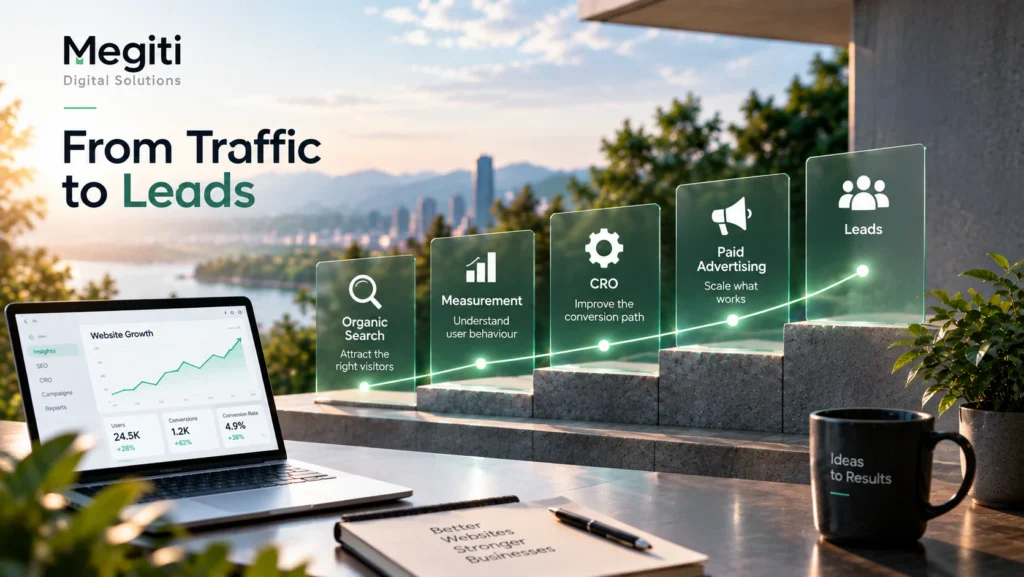
From Traffic to Leads: Website Conversion Optimization, CRO and CTA
Website Conversion Optimization helps turn website traffic into leads by combining conversion measurement, Conversion Rate Optimization (CRO) and Calls to Action (CTA). Organic search and paid advertising work best when they are connected with reliable tracking and a conversion-focused website experience.
Not sure why your website traffic isn’t generating enough leads?
Start by Attracting the Right Traffic
Website growth should connect traffic acquisition, conversion measurement, Conversion Rate Optimization (CRO) and clear Calls to Action (CTA). A practical growth path can be described as: Organic Search → Conversion Measurement → CRO → Paid Advertising → Leads. The objective is not simply to generate more traffic. It is to understand what visitors do, identify where potential customers are lost and improve the path from initial visit to conversion.
Organic Search Optimization helps a website become more visible to people already searching for relevant products, services or information. But ranking in search results is not the final objective. A website may receive increasing organic traffic while generating very few enquiries or sales. When this happens, the problem may no longer be traffic acquisition. It may be the way visitors interact with the website after they arrive. Before investing heavily in additional traffic, businesses should understand whether their existing website can effectively convert the visitors it already receives.
Understand What Visitors Actually Do
Conversion measurement helps track the journey between a page visit and a meaningful business result. A typical path might look like: Page View → CTA View → CTA Click → Form Start → Form Submit → Lead. Tracking only the final form submission is often not enough. If many visitors open a page but very few reach the CTA, the page may be too long, poorly structured or unclear. If visitors see the CTA but rarely click it, the offer, wording, placement or visual prominence may need improvement. If visitors click the CTA but do not complete the form, the problem may be the form itself or another source of friction later in the conversion journey.
Tools such as Google Tag Manager, Google Analytics 4, Google Ads conversion tracking and Meta Pixel can help measure these actions and connect website behaviour with marketing performance. Most importantly, conversion tracking should be working before significant investment in paid advertising begins. Otherwise, a business may know how much traffic it bought but not which campaigns actually generated leads or sales.
CRO: Improve the Path to Conversion
Conversion Rate Optimization (CRO) uses behavioural and conversion data to identify where the website can perform better. CRO is not simply about changing button colours. It may involve landing page structure, navigation, forms, mobile usability, content hierarchy, trust elements, checkout flows and calls to action. The distinction is important:
- Conversion Measurement shows what is happening.
- CRO helps determine what should be improved.
When the analysis identifies problems in the user interface or conversion path, the technical implementation often overlaps with Custom Front-End Development. This may include improving forms, restructuring landing pages, repositioning CTAs, simplifying user journeys or improving mobile interactions.
CTA: Where Interest Becomes Action
A Call to Action gives the visitor a clear next step. Examples include Request a Quote, Contact Us, Book a Consultation, Buy Now or Learn More. However, simply adding a button to a page does not mean that the CTA is effective. Two measurements are particularly useful:
- CTA View shows whether visitors actually reached and saw the call to action.
- CTA Click shows whether visitors who saw it decided to interact with it.
This distinction helps reveal different problems. Many page views but few CTA views may indicate that visitors are not reaching the important part of the page. Many CTA views but few clicks may suggest that the message or offer is not sufficiently compelling. Many CTA clicks but few completed leads may indicate friction in the form or conversion process. This allows website improvements to be based on measurable behaviour rather than assumptions.
Measure Before You Scale
Paid advertising can generate traffic quickly, but sending more visitors into an inefficient conversion path simply increases the amount of traffic being lost. A stronger approach is to first establish the measurement infrastructure, evaluate how existing traffic behaves and improve the most important conversion points.
Once this foundation is in place, Digital Advertising as paid marketing can be used to scale traffic while measuring which campaigns, audiences and landing pages actually generate business results. The process therefore becomes: Attract relevant visitors → Measure behaviour → Improve conversion paths → Scale traffic → Continue optimizing. Organic search and paid advertising are not isolated activities. They work best when connected through reliable measurement and a website designed to guide visitors toward meaningful actions.
Turn Website Traffic Into Measurable Results
A website should do more than attract visitors. It should help move them toward enquiries, leads and sales. Megiti connects Organic Search Optimization, conversion measurement, conversion-focused improvements, Custom Front-End Development and Digital Advertising into a more measurable website growth process. The objective is simple: understand how visitors move through the website, identify where potential customers are being lost and improve the path toward conversion before scaling traffic further.
Related on LinkedIn: Read the perspective on how Organic Search Optimization, Conversion Rate Optimization, and Digital Advertising work together in a website growth strategy.